October 7: Our Lady of the Rosary—Memorial
In the twelfth and thirteenth centuries, the Albigensian heresy was flourishing in southern France. The Albigensians were Christian dualists who believed the Old Testament God was the source of the material world, which was evil, and the New Testament God was the source of the spiritual realm that was good. They rejected the sacraments and promoted extreme asceticism as a way of rejecting the material world.
In 1203, Saint Dominic was traveling through southern France on a diplomatic mission when he encountered this grave heresy. In the two decades to follow, he devoted himself wholeheartedly to rooting out this heresy through preaching and debates. Legend has it that at some point, frustrated with the difficulties he was facing in that mission, he retreated for a few days of prayer and fasting to beseech Our Lady for guidance. Our Lady appeared to him, giving him the Rosary, revealing the mysteries to be meditated upon during the fifteen decades, and exhorting him to preach the mysteries and to pray the decades as a spiritual weapon. The word “Rosary” comes from the Latin rosarium, which means “rose garden.” Each Hail Mary is a spiritual rose; together, they make up the garden of roses. Saint Dominic did as Our Lady instructed him and became quite successful in converting the heretics.
Today’s feast of Our Lady of the Rosary has its roots in a feast named Our Lady of Victory. In the late sixteenth century, the Muslims of the Ottoman Empire were expanding into southeastern Europe and the Mediterranean region. In 1571, Pope Pius V, who was a Dominican, formed an alliance between the Papal States, Spain, Venice, and several other smaller Christian states, called the Holy League, in order to stop Ottoman aggression. On October 7 of that year, the Holy League confronted the Ottoman navy in the Mediterranean, and the pope called upon all of Europe to pray the Rosary for victory. Victory was achieved. In gratitude, Pope Pius V instituted the Feast of Our Lady of Victory to be celebrated on the first Sunday of October every year. Two years later, Pope Gregory XIII changed the name to the Feast of the Holy Rosary. In 1671, the feast was extended to all of Spain, and in 1716, after another important victory against the Muslims, the feast was extended to the entire Church. In 1913, Pius X changed the date from the first Sunday in October to October 7 to preserve the Sunday celebration. Today, this feast is celebrated under the title of Our Lady of the Rosary as a mandatory memorial on the Roman Calendar.
Though war is always gravely unfortunate and should be avoided if at all possible, defense of one’s family and nation is a moral duty when an unjust aggressor attacks. In this case, prayer is the greatest weapon of war, and after the Mass, the Rosary is the greatest prayer to be prayed.
In addition to physical war to protect one’s nation, the Rosary is among the greatest spiritual weapons to fight against every form of evil. Often, even during times of peace, spiritual chaos reigns. Today, due to instant worldwide communication technologies, we are well aware of the many spiritual evils that plague societies and peoples everywhere: wars, corruption, immoral living, flamboyant sins of the flesh, murders, thefts, crimes of hate, moral decay, poverty, and so much more. Rather than just criticizing and condemning such evils, praying the Rosary for those intentions is the best way to combat them.
Our Lady of the Rosary, you entrusted this holy prayer to Saint Dominic, and through him, to the world. You are always attentive to the prayers of the Rosary and never fail to pour forth God’s grace in response. Please pray that I will more deeply comprehend the Rosary’s power and will never fail in my duty to pray it every day. Our Lady of the Rosary, pray for me. Jesus, I trust in You.
Pope Leo in Lourdes: Pray Rosary in October for peace
As he prays the Angelus in Lourdes, France, Pope Leo XIV urges Christians to pray the Holy Rosary for the intention of peace in the world and an end to conflict.
Concluding Mass in Lourdes, on the third day of his Apostolic Journey to France, Pope Leo XIV launched an appeal that he said was “particularly close to my heart, here in this place.”
Just as the Blessed Virgin Mary appeared to St. Bernadette in the Grotto of Lourdes with a Rosary and guided her in prayer, the Pope said he hopes all Christians will pray the Rosary especially during the month of October.
He called for them to pray the Rosary “with the particular intention that wars may cease and that peace may be established among peoples in conflict.”
“Let us accompany this prayer with concrete acts of penance and mercy, committing ourselves always to fostering dialogue and reconciliation,” he said.
Read the full text of Pope Leo's appeal here
Praying the Rosary together
After he returns to the Vatican, many children will gather on October 1 in the Vatican to pray the Rosary together for peace, at 5:00 p.m. at the Lourdes Grotto in the Vatican Gardens.
Between 700 and 1,000 children from schools and parishes in Rome are expected to attend. They will pray with Pope Leo XIV, joining spiritually with children, families, schools, and Christian communities around the world as part of the “One Million Children Praying the Rosary” initiative, promoted by the pontifical foundation Aid to the Church in Need (ACN).
The Rosary prayer will mark the beginning of a worldwide week of prayer culminating on October 7, the feast of Our Lady of the Rosary.
By Devin Watkins Read More Here: https://www.vaticannews.va/en/pope/news/2026-09/pope-leo-xiv-appeal-mass-angelus-prayer-rosary-october.html
October: The Month of the Rosary
Each October, the Church invites us to turn our hearts more deeply to the Holy Rosary, one of the most beloved and powerful prayers in our Catholic tradition. The Rosary is more than a string of beads—it is a prayerful journey through the life of Jesus and Mary, offering us peace, strength, and closeness to God.
Why October?
The month of October was dedicated to the Rosary because of the Feast of Our Lady of the Rosary, celebrated on October 7. This feast was established in thanksgiving for the victory at the Battle of Lepanto in 1571, when Christian forces triumphed through the intercession of Mary, invoked by the faithful praying the Rosary. Since then, Catholics have been encouraged to pray the Rosary, especially in times of need.
The Beauty of the Rosary
The Rosary is sometimes called the “Gospel on a string.” As we pray the prayers—Our Fathers, Hail Marys, and Glory Bes—the beads guide us in meditating on the mysteries of Christ’s life:
- Joyful Mysteries (the early life of Jesus)
- Sorrowful Mysteries (His suffering and death)
- Glorious Mysteries (His Resurrection and the glory of heaven)
- Luminous Mysteries (added by St. John Paul II, highlighting His public ministry)
Through these mysteries, Mary leads us by the hand to contemplate the life of her Son.
Why Pray the Rosary?
Praying the Rosary brings many spiritual fruits:
Relaxing With the Bible Alone - the Truth about sola Scriptura
From "The Catholic Thing" Website:
At times it’s enjoyable to kick your feet up with the Ignatius Bible on your lap and spend a couple of hours reading the Gospels or some of those stirring Old Testament stories. The experience may be so absorbing that we might find it easy to question whether we need priests, bishops, and popes – or even the Church. (Protestants have, for 500 years.) Why not dismiss them all as complicating factors and enjoy the bliss of sola Scriptura? Well, a few nagging details are noticeable.
The Gospels recount Jesus’ words and glorious deeds. After the miraculous multiplication of loaves, the Apostles sail across the sea and encounter Jesus walking on water. Jesus elicits Peter’s momentary faith but saves him from sinking into the waters in a moment of doubt. Ashore, the crowds seek Jesus as their “Bread King,” but he reveals an astounding truth: Jesus is the Bread of Life, and unless we eat His body and drink His blood, we have no life within us.
Except for the Apostles, the disciples scatter in disbelief. The Apostles don’t thumb through their Bibles (which they didn’t have back then anyway). Peter asks, “Lord, to whom shall we go? You have the words of everlasting life.”
The Gospel narrative reaches its decisive moment (Matthew 16:13-20). Jesus asks His disciples, “Who do men say that I am?” They respond, Elijah, John the Baptist, or one of the prophets. But Peter, under the influence of the Holy Spirit, witnesses to the messianic divinity of Jesus: “Thou art the Christ, the Son of the Living God!”
Jesus responds with words that Bible-alone Christians may find difficult to read: “Thou art Peter, and upon this rock I will build my Church, and the gates of Hell will not prevail over it.” It’s a tall order. Peter? Church? Protected from the Devil’s assaults?
From a Bible-alone perspective (what Luther codified as sola Scriptura), it’s an inconvenient truth. Why was a Church necessary in the first place? And if it was necessary, couldn’t He have done better with a qualified, highly educated man, sophisticated in the ways of the world, and relating well to the Jewish elites? Why did Jesus need to identify a mere mortal – and a fisherman at that – as his vicar? Yet after the Resurrection, at Pentecost, the Church emerges publicly under Peter’s apostolic leadership.
We know much of the rest of the story. The Apostles went out to the world to preach the Gospel. Peter’s ministry abruptly ended in Rome, where he was crucified. For a couple of hundred years, his successors suffered similar fates. Yet somehow, the gates of Hell didn’t prevail over the infant Church. That Bible didn’t float down from heaven. It was born into the Church, recognized within the Church, and authoritatively confirmed by her bishops and popes.
Fast forward to the twenty-first century. We won. We have leather-covered Bibles. Some Protestant Bibles are missing important books. Thomas Jefferson took scissors, literally, to the pages of the book and produced a Bible without miracles, limited by Jeffersonian rationalism. Many modern Catholic Bible translations are scarred with political correctness. Despite a few flaws – with a Bible on one’s lap – people often get in the way, unless they’re bringing lunch or dinner.
Church history is distressing. Critics of the popes have always found reasons to complain. Some popes have seemed too silent; others have talked too much. Some have overextended their authority. Others have failed to use it correctly. The popes of the Middle Ages were often so worldly they hardly had time to rule the Church. It’s no wonder the Protestant revolt gained such traction in the sixteenth century. Today, Churchmen opposing the modern machinery of death in its various forms are accused of ivory tower naiveté. Who needs a Church?
Yet, year after year, century after century, Church teaching somehow remains consistent while developing organically in depth and understanding. The simple faithful often identify departures from Apostolic Tradition more easily than highly trained theological experts. Yet the Church’s solemn pronouncements are publicly available and can be verified.
Without an authoritative Church to resolve competing interpretations, the Bible-alone Christian can find himself entering a surreal world of confusion. One Biblical doctrine is emphasized at the expense of another, and eventually the essential question becomes: What, precisely, must one believe for salvation?
Faith is a good and necessary start, but without love – as Saint Paul writes to the Corinthians – we are merely noisy gongs. Without love and repentance, and the assistance of God’s grace, we cannot attain heavenly glory. Scripture itself leads us to Divine Revelation, the Ten Commandments, the Sacraments, and prayer.
So by all means, kick your feet up with the Ignatius (or the Douay-Rheims) Bible on your lap. Read it. Pray it. But don’t forget to ask the question Peter answered: “Lord, to whom shall we go?”
Begin by going to Mass.
Article by Father Jerry J. Pokorsky is a priest of the Diocese of Arlington. He is pastor of St. Catherine of Siena parish in Great Falls, Virginia
Requirements in the Archdiocese of Santa Fe Chapter 11 settlement document
Requirements quoted below in the Archdiocese of Santa Fe Chapter 11 settlement document (the non-monetary covenants)
Non-Monetary Covenants (full text)
Compliance Audit. ASF has engaged a law firm to serve as a consultant to conduct an independent audit of compliance with the Archdiocese’s reporting policies and procedures and to provide recommendations on child protection policies and procedures. … ASF Parties shall post such findings on their websites with one-click access from the website home pages.
Improved Reporting Mechanism. ASF Parties shall, through a prominent (“one click”) link on their websites, provide a phone number and email to which anonymous abuse complaints can be made.
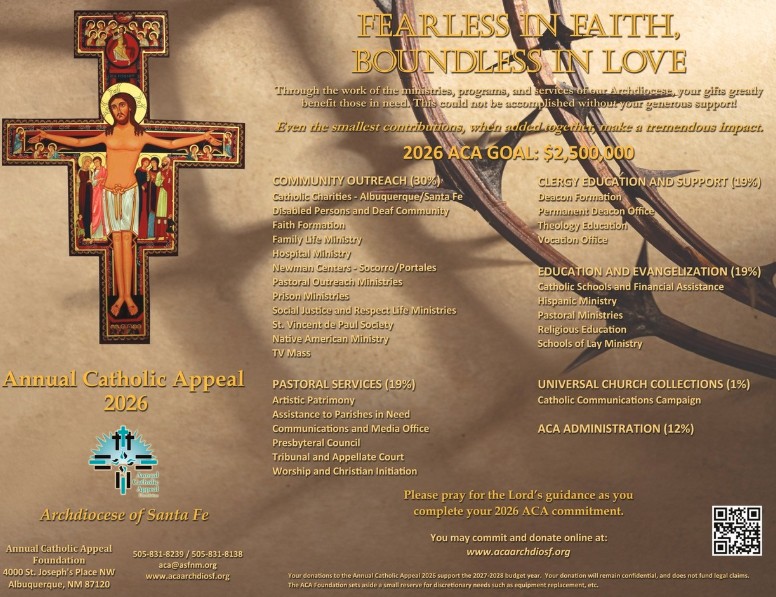
Annual Catholic Appeal 2026 - Fearless in Faith, Boundless in Love
Donate and Pledge here: https://archdiocesesantafegiving.org/annual-catholic-appeal-foundation
Business Opportunity - Adoration Chapel Construction
San Clemente Parish in Los Lunas, NM is requesting bids from qualified contractors for the construction of a new Adoration Chapel located in what is now the parking lot of the San Clemente Parish. Bids are due on May 29, 2026 at 1:00 pm at the Parish Office located at 244 Luna Avenue NE, Los Lunas, NM 87031. Phone Number; (505) 865-7385 Questions related to the information and/or requirements in the posting can be emailed to Project Manager Eric Zamora, This email address is being protected from spambots. You need JavaScript enabled to view it.. Questions shall be submitted no later than 72 hours before the close date of this posting. Questions submitted after the deadline may not be answered.
For this posting, “Offeror” refers to a company interested in proposing the opportunity to become a contractor. “contractor” refers to a company with a direct contracted relationship with San Clemente Parish and “ subcontractors” refers to companies that the contractor may contract with to perform various scopes of work under the opportunity.
The Consequences of in vitro fertilization (IVF) and birth control
The Population Research Institute (pop.org) is a non-profit research group whose goals are to…
- expose the myth of overpopulation
- expose human rights abuses committed in population control programs
- make the case that people are the world’s greatest resource
Our growing global network of pro-life groups spans over 80 countries.
We are especially proud of the projects you've helped us complete this year—initiatives that have brought vital information to people like you who care deeply about these issues.
Among these are two new educational efforts to shed light on the overlooked (or purposefully hidden…) consequences of in vitro fertilization (IVF) and birth control.
In Vitro Fertilization (IVF):
There are ways to increase the birth rate–as the incoming Trump administration correctly wants to do–but IVF is not the way to do it.
In Vitro Fertilization (IVF) was a hot topic in 2024, but most people don’t understand how it works. They are unaware of the dozens of embryos that are routinely destroyed in the IVF procedure and the damaging physical and mental effects that IVF can have on couples. As insurance companies push for broader IVF coverage, more couples will be tempted to resort to it—without a clear understanding of its risks and consequences.
Anyone who may be tempted to go down the IVF road needs to read our report, “In Vitro Fertilization: The Process, Risks, and Consequences Explained.”
The Dark Side of Birth Control:
Powerful drugs should not be administered without informed consent, but millions of women and girls have been left in the dark when it comes to the serious side effects of oral hormonal birth control (“the Pill”). Years of taking the Pill can damage a woman’s physical and mental health, and even leave them infertile. But few connect the problems affecting their bodies, their brains, and their overall sense of well-being with the steroid-based hormones they have been swallowing daily.
We will break down the widespread, often hidden, effects of birth control, in a three-part report and video series. The first, addressing the physical side effects, is called, “Breaking the Silence: The Dark Side of Birth Control’s Physical Impact.”
The pro-contraception and pro-abortion movement targets women, and their unborn babies, in many different ways, as you know, and an important part of our mission is to EXPOSE them by creating resources for you and for the general public.
To get the facts about IVF:
https://www.pop.org/in-vitro-fertilization-the-process-risks-consequences-explained/
To learn more about the dark side of birth control:
https://www.pop.org/birth-control-pill-fact-sheet/
Take advantage of these links anytime! Share them with your family members or friends who want to educate themselves on the evil that the abortion lobby wants to push on our nation and the world at large.
The fight for Life begins with education.
With your continued support, we will keep researching critical pro-life issues and sharing the truth with as many people as possible.
https://www.pop.org/donate/eoy/
Thank you for your support of our efforts to stop the spread of abortion and defund population control programs. We have been “Putting People First” for more than thirty years now. Our goal is to create a thriving Culture of Life at home and abroad.
But if we save even one unborn life, it will have been well worth it.
Read more here: https://www.pop.org/weekly-briefing/
Archdiocese of Santa Fe Annual Catholic Appeal 2025
See video below or click on the Archdiocese of Santa Fe Annual-Catholic Appeal-Foundation
Make your pledge here: https://secure.acceptiva.com/?cst=sXceey